Sega is running its company like a 2010s corporation and wondering why its games aren't selling
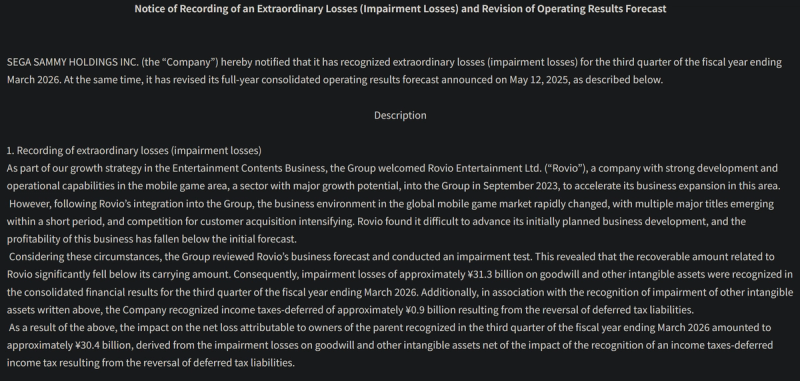
"The business environment in the global mobile game market rapidly changed." Pure corporate cope. The market did not suddenly shift the exact second you signed the cheque. You just paid nearly $800 million for a dying 2010s slingshot game and finally realised the rest of the world moved on a decade ago.
Sega Sammy President Haruki Satomi recently had a very public wake-up call during an earnings Q&A. He admitted a rather frustrating truth for his boardroom. Sega is releasing games that review incredibly well, yet gamers are simply not buying them at expected volumes. He openly confessed that things have grown stagnant and that high critical evaluations have yet to translate into actual unit sales.
My immediate reaction was pure disbelief. The absolute disconnect between the Sega boardroom and the actual gaming community is insane. Sega is panicking over low sales while completely ignoring that they are actively driving their own customers away.
If you read my recent breakdown on Sega and the Yakuza fatigue, you already know exactly how greedy their monetisation has become. Locking core features like New Game+ behind a £15 paywall and churning out endless spin-offs has destroyed a ton of goodwill. But the corporate brain rot goes so much deeper than just Ryu Ga Gotoku Studio.
The illusion of AAA and the AA budget reality:
Sega has not released a genuine high-budget, true AAA title in the last two decades. There is simply no eye-catching visual leap or innovative ‘wow’ factor that you can slap on the box art to sell units. They mass-produce games on rigid AA budgets, recycle assets endlessly on PS4-era engines, and still have the absolute audacity to charge you £60 or more for the privilege.
Metaphor: ReFantazio is the perfect example of this delusion. Sega tried to hype it up as their next massive, groundbreaking pillar. Let us be real. It was essentially a Persona reskin. The art direction was way too similar, the graphics looked instantly dated, and it completely lacked the cutting-edge innovation needed to justify a premium AAA price point. People are probably already expecting a definitive edition later this year anyway.
Training your audience to ignore launch day:
Atlus has literally trained their own customers to stop buying their games on day one. The community is genuinely exhausted by the definitive edition scam. It is an incredibly outdated way to handle expansions, completely behind the times compared to how modern studios release actual DLC.
We saw it with Persona 5 Royal and we saw it again with Shin Megami Tensei V: Vengeance. Do not get me wrong, Vengeance is likely my favourite game of the decade. But even as a full-priced definitive edition, it still has glaring areas that feel fundamentally unfinished and incomplete. If even their absolute best releases suffer from this outdated model, why on earth would anyone pay full price for a base game at launch?
Punishing paying customers with Denuvo delusions:
Is Denuvo the sole reason Sega games are not selling? Obviously not. But it is an utterly pointless, anti-consumer middle finger to their PC community. Nothing highlights corporate paranoia quite like Sega's obsession with slapping this intrusive, performance-tanking software on almost everything they publish.
Their Denuvo delusions reached absolute peak comedy when they forced it onto the Steam port of Persona 3 Portable. Think about how disgustingly brain-dead that is. Sega is actively punishing legitimate, paying PC players by shoving heavy DRM into a literal PSP game. It is actually hilarious. Nobody is trying to pirate a compressed visual novel from 2009 with that much desperation. If your game looks like a relic from three console generations ago, treating your buyers like common criminals is a phenomenal way to ensure your PC goodwill stays in the gutter.
Burning millions on dead trends instead of guaranteed hits:
Sega consistently chases live-service fads and totally ignores guaranteed money-makers. The most ridiculous burning of cash recently happened with Creative Assembly.
Sega forced a studio legendary for historical grand strategy to waste over $100 million on Hyenas, a trendy sci-fi hero shooter. They realised it was going to be an absolute disaster and binned it weeks before launch. Imagine the sheer stupidity of blowing that kind of budget on a saturated trend instead of just letting Creative Assembly build a massive, highly anticipated sequel like Medieval 3 (before the recent teaser) or Shogun 3.
Instead of funding the massive historical IP sequels the community actually wants, Creative Assembly is stuck making money for Games Workshop. Sega has them pumping out low-effort, low-quality Warhammer DLCs and pointless filler games like Total War: Pharaoh. Well done Sega.
The massive $800 million Angry Birds punchline:
If you want to see the absolute peak of corporate incompetence, look at the Rovio acquisition. In 2023, Sega paid $776 million for the creators of Angry Birds.
To put this financial black hole into modern gaming terms, Sega spent the equivalent of nearly three entire Concords on a dead touchscreen slingshot game. Three Concords worth of cash and failure completely set on fire.
To put that insanity into further perspective, Sony and Tencent previously bought a 30% stake in FromSoftware for about $260 million. Sega could have bought outright ownership of the studio that created Elden Ring for the exact same price they paid for a dead 2010s mobile fad.
Why did they do it? Sega panicked over a bidding war and threw insane money at Rovio purely to acquire their proprietary mobile engine called Beacon. They thought they could plug their core Japanese IPs directly into Rovio's tech and instantly print money.
The reality hit them immediately. Beacon only works well for casual puzzle games. When Sega tried to apply that tech to their own core titles, they realised it was completely incompatible. They spent a fortune on an engine they cannot even incorporate into their own services. For the amount of money they wasted, they could have funded three or four massive AAA games.
A pathetic excuse for a rapidly changing market:
Because the studio is clearly not making enough profit to save itself, Sega just had to legally write off roughly $200 million as an impairment loss on Rovio earlier this year.
In their financial report, Sega legally tried to tell their shareholders that the global mobile market "rapidly changed" right after they bought Rovio. They blamed multiple major titles emerging and intensifying competition.
Let us actually dissect that utterly pathetic excuse. What an absolute load of nonsense. The mobile market did not suddenly mutate overnight. It has been a hyper-competitive bloodbath dominated by massive live-service garbages for years. Literally everyone with a smartphone already knew Angry Birds was a completely irrelevant relic from the early 2010s.
The market did not change. Sega simply bought a depreciating asset at the absolute peak of a corporate bidding war bubble. Now they are trying to blame the business environment instead of admitting their own executives completely failed to do a five-minute Google search on current gaming trends.
The Rovio deal instantly imploded:
The rest of the fallout from this baffling purchase is deeply embarrassing. Here is exactly what else Sega got for their money.
A cancelled console expansion: Rovio had opened Studio Lumi in Montreal to build big-budget console games. Months after Sega bought them, Sega shut the studio down and cancelled their unannounced game. What were they even paying for at that point?
A massive flop: Sega had Rovio co-develop a mobile party game called Sonic Rumble. It launched, failed to attract a player base, and completely faceplanted.
✅ The Verdict
Sega expected a synergy cheat code. They hired expensive financial consultants who looked at Angry Birds having global brand awareness and assumed it was a multi-billion dollar empire waiting to happen. They treated game development like a corporate spreadsheet projection.
Haruki Satomi only had to just walked down to the actual development floor and consulted his own senior programmers if dropping nearly $800 million for the Angry Birds engine was a good idea. 1 hour of discussion and research would have saved them 3 Concords.
You simply cannot force gamers to buy overpriced AA titles, paywalled features, and dead mobile fads. Sega is now desperately trying to milk nostalgia by reviving Crazy Taxi and Golden Axe all at once to save their bottom line. Until they unplug from their 2010s corporate bubble and stop relying on out-of-touch boardroom math, their games will continue to sit on the shelf.