Tokenmaxxing was the quickest reality check for out-of-touch corporate execs
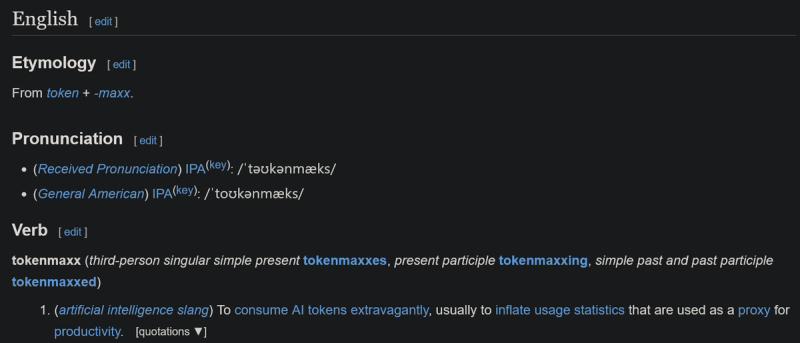
Let's talk about the brain rot that consumed the tech industry for the first half of 2026. The end of the Zero Interest Rate Policy (ZIRP) era hit these out-of-touch corporate executives hard. With the free money tap firmly shut off, they desperately needed to prove to shareholders that the billions they sank into generative AI were actually yielding results.
Because they had no idea how to measure real value, they resorted to the laziest possible metric. They invented "tokenmaxxing". Management decided that the sheer volume of AI tokens a developer burned was a direct proxy for their productivity. It was a vastly more expensive version of measuring output by lines of code. Back in the normal days of office life, if you wanted to fake productivity, you walked around looking stressed with a clipboard or typed out emails you never intended to send. Today, you fake productivity by setting millions of dollars of server compute on fire, accelerating the death of the planet, and generating mountains of automated digital garbage for an actual senior developer to clean up.
Gamifying a server fire: The hall of fame of stupidity:
The scale of the waste was genuinely hilarious. Companies built gamified dashboards to track how much compute their employees could burn, effectively handing out promotions to whoever could rack up the highest cloud bill.
Here is a quick look at the biggest clowns of the trend:
Meta and the "Cache Wizards": Meta built an internal leaderboard tracking employee AI usage. In a single 30-day window, the company collectively incinerated 60 trillion tokens. They handed out literal titles like "Cache Wizard" to the top spenders, including one individual who burned 281 billion tokens alone.
The $500 million Claude Code invoice: An unnamed enterprise client, widely rumoured to be Amazon, gave its developers uncapped access to Anthropic's Claude. Because there were no budget stops, engineers set up automated agentic loops that ran around the clock. The company racked up a half-billion-dollar tab in a single month before finance even noticed. Amazon had to abruptly nuke its internal "KiroRank" leaderboard in a blind panic.
Uber blew its budget: Uber admitted it burned through its entire 2026 AI coding budget by April.
Jensen Huang's ridiculous math: Nvidia's CEO publicly declared that a $500,000 a year engineer should be consuming at least $250,000 in tokens annually. Of course he said that. He sells the shovels.
Welcome to the code slop factory:
Anyone who actually writes software for a living saw exactly how this was going to end. If you tell developers their performance review depends on high token usage, they will optimise for it. They hooked up AI agents to repositories, spawned hundreds of useless sub-tasks, and let them loop infinitely.
The result was an ocean of automated code slop. Highly paid Senior and Staff Engineers were suddenly demoted to being AI janitors. Instead of architecting new features, they spent their days untangling hallucinated logic and cleaning up bloated garbage generated by rogue agents.
The data is out, and it proves how much of a disaster this was. Enterprise tooling company Odin AI tracked 22,000 developers in high-adoption environments. They found that thanks to tokenmaxxing, bugs spiked by 54% and code churn skyrocketed by an unbelievable 861%. Developers built automated factories to generate digital landfill just to hit their quotas.
The hilarious backpedal to modelmaxxing:
By early July 2026, the financial hangover had fully set in. Tech giants realised they were paying autonomous AI agents by the second to write broken code. The pivot away from tokenmaxxing has been frantic.
Microsoft literally passed the bill for its own hype cycle onto the consumer by quietly jacking up GitHub Copilot pricing based on token use. Meanwhile, companies like IBM desperately tried to rebrand the mess by pushing a new buzzword called "valuemaxxing".
The most popular corporate cope right now is "modelmaxxing". Executives are writing thought leadership pieces declaring that the real secret is task routing. They want to use expensive frontier models for hard tasks and cheap models for simple tasks. They act like this is a genius revelation. Coinbase CEO Brian Armstrong even went on a media tour bragging about how he cut his AI bill in half by using cheaper defaults like GLM 5.2 and Kimi 2.7. This is a guy who already runs a crypto casino grift, now desperately trying to staple GenAI hype on top of it, whilst acting like he just invented the concept of cost control.
Benchmaxxed models and the simple task fallacy:
The tech industry is acting like model routing is the silver bullet. They are just replacing one fundamentally broken paradigm with another.
Take a look at the Chinese open-weight model GLM 5.2. On paper, executives look at it and see that it scores high on coding benchmarks. But it is entirely rigged. GLM 5.2 is notoriously benchmaxxed. It basically memorised the evaluation datasets. The second you drop a benchmaxxed model into a massive, undocumented proprietary enterprise codebase, it confidently spits out garbage.
The core premise of model routing relies on offloading "simple tasks". But what actually dictates a "simple task" in an automated pipeline? Formatting a JSON file? Writing a basic regex? Extracting variables? In an automated workflow, a "simple" mistake at step two catastrophically cascades into step fifty. If a cheap, highly flawed model hallucinates a single comma in a config file, it breaks the entire multi-million dollar agent loop.
Then there is the router tax. To make modelmaxxing work, you need a system that evaluates an incoming prompt and decides if it is easy enough for the cheap model or if it needs the expensive one. How do you do that accurately? You have to use an expensive frontier model to act as the router. Companies are literally spending compute just to decide how to spend compute. If the router gets it wrong and sends a complex prompt to a cheap model, you just get a fast, cheap hallucination that poisons the whole codebase.
This creates the exact babysitter paradox anyway. If you use a cheap model to process data, someone has to verify it. You are either paying a human engineer to spend four hours debugging subtle logic errors to save 12 cents in compute, or you have to run the output through an expensive frontier model to verify it anyway.
The grifter closed loop: Buying startups while firing humans:
Perhaps the most offensive part of this whole circus is the parasitic micro-industry it spawned. Because tech giants handed developers a blank cheque and zero oversight, a new wave of GenAI grifter startups appeared overnight. Their entire business model is selling solutions to a problem that generative AI created in the first place.
Look at companies like Faros AI and Harness AI. In June, they aggressively pivoted to launch tools like "Token Intelligence" and "AI DLC Insights". What do these actually do? They are just automated babysitters designed to stop a rogue coding agent from dumping a whole repository into a context window and racking up a $5,000 AWS bill while the boss is asleep. Microsoft even had the nerve to team up with Google and IBM to back the new "Tokenomics Foundation" to establish industry standards to fix a mess they actively encouraged.
It is a perfect, closed loop of corporate grift. The big tech giants buy up these useless babysitting startups for tens of millions of dollars to plug the holes in their own leaky AI ships. Then, a week later, they announce massive layoffs of actual human engineers because their operating costs are suddenly "unsustainable". They are literally sacking the senior developers who actually know how the codebase works, just so they can afford to buy a startup that monitors the AI slop generator they bought last year. But sure, keep telling us this is totally not a bubble.
✅ The Verdict
When historians look back at the 2020s, they will categorise it as mass psychosis. We started the decade buying receipts for ugly cartoon apes. Then we burned $40 billion forcing employees to have virtual reality meetings without legs. Now, we are handing out company awards to engineers who can burn the most millions of dollars having an AI bot write code that does not even compile.
Tokenmaxxing was what happened when toxic hustle culture collided with AI hype. It is a perfect encapsulation of a tech industry that has too much money, zero connection to reality, and a desperate need to manufacture the illusion of progress.